How is it that Barca can play five up front? — May 6, 2025

How is it that Barca can play five up front?

The five up front is akin to the old-style W-M formation including two wingers, a centre forward and two inside forwards – No.8 and No.10.   Certainly, this presents a handful to the opposition backline, back four or five.   This is really a statement about having two completely different shapes depending on whether you are attacking (in possession) or defending (out of possession).   Rather than just tweaking the odd player here and there, and primarily sticking to your 4-2-3-1 or whatever it is, this is having a completely different formation when you are in possession.

It can take time to set up and Barca have this key ingredient of being able to keep the ball.   This is vital.   Other teams have this ability as well but do not commit so many players forward.   Having so many players in advanced positions allows for more flexibility in creating scoring opportunities.   In the first leg of their Champions League semi-final tie with Inter Milan, Barca were able to produce a set play in open play to draw level at 2-2.   They even had the audacity to practice the move in the warm-up before the game.   They are also renowned for playing with a high line.   The opposition must initially break through their gegenpress, another feature of Barcelona’s play.

Gegenpressing is a different type of press where the ball aims to be won back as soon as possession is lost.   It tends to be utilised at the middle to higher end of the pitch and has found many plaudits since Barcelona pioneered this way of playing.   When possession is lost, players in the vicinity swarm around the ball and pressurise the ball-carrier.   The outlets for passing the ball are shut off which doesn’t give the player on the ball a moment and forces the mistake.

When the opposition have secured possession and progressed into the opponent’s defensive half, Barcelona will still be playing with a high line.   The idea being to compress play by reducing the size of the playing area.   A potential disadvantage is that you are creating a bigger open space between the last line of defence and the goalkeeper.   Maintaining pressure on the ball is a key objective for this strategy to be effective.

The defensive shape is a zonal shape.   By squeezing play into a very condensed space, play can be very congested.   It means defenders are more able to apply pressure on the ball.   If I compare the implementation of this type of defence in football to that of basketball, there is one glaring difference.   The compactness of the zonal defence is positioned directly in front of one’s goal in basketball – not in the middle of the court.   There is no space behind the defensive unit.

With any defensive system there is always a weakness.   The open green space behind the defensive line is what Inter Milan will be looking to exploit in their 2nd leg this evening.

Manchester City stun Villa with late goal — Apr 23, 2025

Manchester City stun Villa with late goal

There’s a well-known adage in basketball, when defending one-against-one, “cut-off the baseline.”   The baseline equates to the bye-line in football.

In the Premier League game last night, Manchester City v Aston Villa, both teams were vying for Champions League qualification.   Marcus Rashford was put through on just seventeen seconds into the game and was unfortunate that his shot hit the post and rebounded back straight into the hands of the goalkeeper.

Then, Man City took the lead.   Marmoush was attacking down the left up against the full-back, Matty Cash.   There was another Villa player on hand to help-out Cash which would have been ideal for the full-back to work with in showing the forward the inside track.   The decision was made to show the winger the outside track, to the bye-line.   The cross was made and turned in at the far post.

Villa got back on terms when a penalty was awarded belatedly but deservedly following a VAR intervention.   Rashford, a reformed player since leaving United, stepped up and despatched it confidently.

Now, with the five minutes of stoppage time at the end of full-time virtually complete, City are again attacking down the left.   A different full-back this time, Cash had been substituted, and he was more isolated as his teammate had just made a token challenge on the newly arrived substitute, Doku, in so doing removed himself from the action.   This is a separate issue altogether.

Doku, known for his exciting pace and extraordinary wing play, was again shown the outside track.   This is obviously club policy.   Not unlike their first goal, Doku’s blistering pace took him to the bye-line, the cross despatched and City were triumphant and move to third in the Premier League, eyeing a Champions League spot.

Generally, in football the preferred option when a defender is one-on-one with an attacker in and around the box is to show the attacker “the line” or outside track.   This strategy may stem from a zonal defensive system that does not prioritise the support role of the defenders.   This is not necessarily an incorrect strategy but, depending on the circumstances, it may not be a correct one.   The case for showing down the line is that there is a reduced angle for a shot on goal and a better chance of making a tackle which would also cancel out any potential danger from a cross.   The inside track potentially steers the opponent into traffic but opens-up the angle for a shot on goal.

On both occasions the tackle was not made and highlights the need for a second defender in these situations which then puts the advantage with the defending team.   Basketball could well have something to offer football!

Channel 4 Football Dreams — Aug 12, 2022

Channel 4 Football Dreams

To all my follower out there, I’m back.   You may have noticed that I haven’t posted for a while and there is a reason for that.   I’ve concentrated and been preoccupied with writing a book.   And I am proud to announce the book is finished.

A basic premise of the book is to look at the nature of defending and to try and answer the question of why it is that so many goals are conceded when the player scoring the goal is completely unmarked.   But more of this later.

I watched the first episode of Football Dreams: The Academy a new Channel 4 documentary series last night.   It follows Crystal Palace revealing the work that goes in to developing the next generation of footballing talent.

One lad, Bola, age 11 we are told is a left-footed full-back.   Is it right that clubs allow young players to identify with specific positions from such an early age?   They also talk unashamedly in terms of defenders and attackers.   We’re all defenders, and attackers!

A Left-Back in the modern game will need to be able to defend but also to get forward on the overlap, cross balls and feel comfortable in taking players on.   A bit like a Left Winger might do.   In short, the defender needs to equip themselves with a host of attacking qualities.   All this is, should be considered alongside developing the right-hand side of his play.   If it’s not developed from a young age, it is unlikely to be later.   A football education should be about developing the complete footballer.

When it comes to defending, fifty percent of the time you haven’t got the ball.   All teams are seeking a goal scorer, but the other side of the coin is to not concede goals.   Defending.   The skills and development on this side of the game are sometimes not given the same credence.   There is already a whiff of one player developing the wrong attitude as portrayed by the under-12s coach Phil Hingston repeating the message to stay humble.

This may come across as a chilling statistic as it is on the back of goals conceded in the first week of the Premier League which in 2015 saw 67% goals scored were completely unmarked.   2018 64%, 2021 76%.   Analysis of last week’s goals saw a whopping 92% of goals scored were completely unmarked.   Two of these goals were when the defender was making a late lunge for the ball, but even if you discount these it is still 86%.

Get the book!

Essay on Defending — Oct 21, 2020

Essay on Defending

Tottenham 3 West Ham 3 – Premier League Sunday 18 October 2020

When it comes to defending in football, if you haven’t got pressure on the ball you haven’t got control.   Pressure means not giving the opponent freedom on the ball to do what they like including the playing of long passes.   It doesn’t matter what system you play: if you like to play offside with a flat backline and there is no pressure on the ball, the backline is extremely vulnerable.

In theory, backline players should be able to see there is no pressure on the ball and make the decision to drop-off to safeguard against the ball over the top.   In other words, abandon the backline.   In practice, it is a very different matter.   Coaches would have a fit if they saw one of their backline players doing that.   You could argue that this might be the only way to get the point across of the importance of putting pressure on the ball-carrier for backline players to do just that.

It is not possible to exert this kind of pressure all the time, but it is about sensing those moments when an opponent is about to get free on the ball, their head is up and looking to make the crucial pass.   This is why playing a form of team man-to-man defence helps to satisfy this most fundamental of defensive principles.   It provides a refreshing alternative to keep switching markers and running from one player to the next, chasing the ball type of defending.   Once you can be reasonably assured of providing pressure on the ball-carrier, the flatness of the backline and the playing of offside becomes much less of an issue as the killer pass will become far more difficult to execute.   It is then just a matter of players learning good individual man-to-man defensive technique.

This is why formations are only the starting point when it comes to defending.   From within the formation players have to match-up with opponents respectively.   According to your position on the field, the opponent you take responsibility for has to be in consideration that fellow teammates are appropriately positioned to mark other key opponents.   This awareness comes primarily from playing man-to-man.   It doesn’t come from playing zonal.   In fact, there are not many facets of good defensive technique that do come from zonal defending.   But, when you have learned those individual techniques, zonal defending can be very effective.   It’s the little things that you may think aren’t particularly significant that can make the difference.   Often, it’s trying to win the ball instead of saying to the opponent “you beat me”.   Diving in can be extremely costly if you don’t win the ball cleanly, not least because you lose goal-side position.

Tottenham were 3-0 up in the first sixteen minutes of this encounter.   The first goal scored inside the first minute was one that seems to catch defences out time and again.   It was a long ball from Harry Kane who seemed to be playing in a much deeper role, collected the ball from just outside his own penalty area.   Looked up and played a sixty-yard ball over the top of West Ham’s defence to the on-running Son Heung-min.   This was a set move and fully explained why Kane was playing so deep.

From a defensive perspective there are various discussion points.   West Ham’s backline being pushed up to half-way, nothing unusual there.   The main factor being when Kane collected the ball, he was completely unmarked.   This is where defensive instincts have a part to play.   Often it is said that the defender didn’t react or when they did it was too late.

The defender, Fabián Balbuena, should anticipate the ball over the top.   But, in anticipating it, he has to predict this possible play by Kane almost before Kane has!   The red lights on the dashboard should be flashing for the defender as it is apparent Kane has the freedom on the ball to do what he likes.   If Balbuena doesn’t react until Kane has looked up and spotted the pass, it will be too late.   With Son already up to speed and the defender static and facing the opposite direction, it is no contest as to who is going to get to the ball first.

If there had been pressure on the ball when Kane received the ball, this would be a different scenario altogether.   But there wasn’t.   What then was Balbuena supposed to do?   Herein lies the other major difficulty for central defenders.   Contrary to received wisdom of how defenders should behave in these situations, he ought to have abandoned the defensive line.   As soon as he saw the ball being played to Kane and before Kane had even touched the ball, the defender should have made a quick retreat.   He could see that Kane was completely unmarked.   By taking this action, Balbuena is now stealing a march on Son, rather than the other way around.   If Kane looks up and sees a defender already retreating and, crucially, maintaining a goal-side position on Son, he may not even make the pass.

This kind of behaviour goes completely against the grain of the modern central defender.   It is akin to the days of the ‘sweeper’ in football.   The defensive line is sacrosanct.   The only negotiation is whether the line is high, middle or low.   The ability of a player to be able to predict and then anticipate the play in this way is a highly sophisticated skill.   It is part of good individual technique.   The fixation of having to play with this defensive line requires closer scrutiny.   At the precise moment when Kane receives the ball, what is the point of having a flat defensive line?   What is it achieving?   There needs to be a good reason because you are offering a very appetising stretch of land between the backline and goal for opponents to exploit.   If the answer is compressing play, think again.

Kane wasn’t being compressed at all.   This is because he wasn’t being marked.   Wanting to pursue and playing with a flat backline is a desirable tactic but it needs to be supported by the most basic of defensive principles – pressure on the ball-carrier.   Receiving the ball in the area he did, it is sometimes difficult to exert the necessary pressure on the ball.   Quite often during the transition phase the organisation of players higher up the field is not always up to scratch.   Under these circumstances, adjustments may have to be made in other areas of the defensive shape like the backline.

Spotting and anticipating the play by Kane is not easy.   A possible solution is to just position a defender in this withdrawn position behind the backline while the ball is still in the opponents own third.   Son may want to push up onto this defender into the space created by such a position.   It reduces the target area but more importantly it enables the defender to have a goal-side position on the attacking player.   Balbuena wasn’t marking anybody while he was holding his position on the half-way line.   Now, he can at least mark Son from a good defensive position.   The problem for central defenders generally is that they are not allowed to adopt such an unorthodox position.   This is not how football is played.   It is important that a regimented flat backline is maintained at all costs.   Seemingly if that cost is conceding a goal.

Balbuena was able to chase and offer some defence against Son, the nature of which was also questionable given that he was in a one-versus-one situation and should really have been steering Son down the line.   Son just cut inside and despatched the ball into the far corner.   Individual technique once again being brought into the spotlight.   Having set up the first one, Kane scored twice to go 3-0.   After eighty-two minutes, Spurs were still 3-0 up.   Balbuena was then on the scoresheet with a header followed by an own goal from Davinson Sánchez.   The stage was set for what might well become the goal of the season.   A blistering shot, by Manuel Lanzini who hadn’t long been on the pitch, from just outside the box.   The ball swerving away from the keeper Lloris’ reach as the ball ricocheted around the stanchion before nestling in the bottom of the net.   The playfulness of the ball just added greater effect to the occasion and was the final drama of the match.

Basketball can provide clarity for VAR woes — Sep 29, 2020

Basketball can provide clarity for VAR woes

Was it handball?   Did the player dive?

When it comes to the awarding of penalties we need clear guidelines.

At the moment, seasoned professionals cannot agree.   The referee in the middle has to make an on-the-spur-of-the-moment decision which is often overturned by fellow professionals at Critchley Park who have the benefit of time to consider the various factors.   The VAR decision is still often contentious.   The “factors” of what is deemed a penalty or, indeed, what is not a penalty are unclear.   We need clarity, not just for the Premier League football but for all professional football as well as those who play the game at grass-roots level.

It may sound odd that basketball can offer any help over the defining of clear guidelines particularly when it comes to things like handball.   There is no such thing as handball in basketball.   The game is all about using one’s hands.   Handball in football can be considered a foul and there are clear guidelines in place, where basketball is concerned, as to what constitutes a foul.   You only have a personal tally of five fouls in basketball before you have to leave the game.   Personal contact is the main reason for awarding a foul.   A player needs to know exactly what behaviours are likely to lead towards the awarding of a foul.   It is an unwritten rule in basketball that individual players should operate within a cylindrical shape if they do not want to incur a foul.   This means that players have to keep their bodies, including arms and legs, within the imaginary cylinder.   If an arm or a leg comes outside the cylinder shape and there is contact with an opponent, a foul could ensue.   These same principles ought to be the ones that apply to fouls in football.

The Eric Dier handball which resulted in Tottenham conceding a penalty at the end of their match with Newcastle at the weekend has caused a certain amount of controversy.   Jamie Carragher’s point is that you can’t jump without raising your arms, therefore it wasn’t a penalty.   Roy Keene saying it was a penalty because it hit an out-flaying arm of Dier’s.   The basketball principles would concur with Keene.

The point here is that whilst it may be more difficult to jump not using one’s arms, in fact Dier did jump not using his arms.   It was only as he landed did the arm go up in the air, outside the cylindrical shape, and the ball hit his arm.   The other way of viewing this from a player perspective is if you do want to use your arms in jumping better make sure you also win the ball.

The same principles should apply on the ground in the penalty box.   If a leg comes out, usually with the view to winning the ball, and contact occurs you risk giving a penalty away.   Defensive technique needs to adapt to not trying to win the ball, particularly in the penalty area.   Defending players should concentrate on moving one’s feet quickly in order to maintain a good defensive position.   There is a drill often used as a training exercise in basketball where the defensive player defends one-versus-one against the attacking player with the ball with their hands behind the back.   Defend with your feet, not your hands.   Footballers should also defend with their feet and do not try to win the ball.

Zonal mentality costs Manchester United a place in the Europa League Final — Aug 17, 2020

Zonal mentality costs Manchester United a place in the Europa League Final


Sevilla 2-1 Man Utd

You can call it poor defending or defensive lapses in concentration but there are systemic issues here that need addressing.   Attacking flair is great and United have this in abundance but the other side of the game is to be resolute in defence.

It’s an old cliché that space doesn’t score goals, players do.   This is why defenders need to mark players and not space.   It involves understanding the precise moment of when to switch to a man-to-man role within a zonal format.    This, clearly, does not come naturally to the players at the heart of United’s defence.

There is a reason for this.   It is to do with players never having played full team man-to-man defence competitively.   Only through playing and experiencing this form of defence does one really begin to understand the subtle art of defending one against one – a fundamental characteristic of zonal defending.

When your goal is coming under threat this is not a time to be playing a flat backline or trying to play offside.   This is a time to make sure opponents are being marked.   Unfortunately, the two objectives are not compatible.

Two goals, both where the player scoring the goal is completely unmarked, marked United’s exit from Europe.   The first one, the young full-back Brandon Williams did not see the need for him to be adopting a goal-side position for the equalising goal.   The second, the other full-back Aaron Wan-Bissaka was actually stood alongside De Jong on the top of the box as the play developed down the right-hand side.   As De Jong attacked the box the full-back did not go with him.   He probably didn’t even think he needed to.   This is the zonal mentality.

Wan-Bassaka was more interested in holding a defensive line.   When you are square with the position of the ball there is absolutely no point in trying to hold a defensive line.   De Jong was able to amble through the centre of the defence and arrive in the middle of the goal area to find himself completely unmarked for a simple tap-in.

With any defensive system, there comes a point when players have to match-up one against one with opposition players.   United have paid the price for not managing to do that.

Lampard’s defensive woes will not go away — Aug 3, 2020

Lampard’s defensive woes will not go away

The issues around poor defensive technique continued to haunt Chelsea in this F A cup London-derby final.   After a promising start and utilising a carefully managed pressing technique they took a well-deserved lead courtesy of an audacious piece of skill from Pulisic.

Chelsea like to play a high line and such a tactic requires applying pressure to the ball-carrier and, if this is not possible, the backline need to be on red alert.   Unfortunately, Azpilicueta was not and his lack of pace was exposed by the long ball played by Kieran Tierney into the path of Aubameyang.   Arsenal’s talisman was able to keep Azpilicueta on his back and was duly brought down in the box to concede a penalty.   1-1.

I posted a detailed analysis of the goals Chelsea conceded in the thrashing they received from Manchester United on the opening day of the season.   It would seem the same mistakes are still being made.

The second and winning goal completed a brace for Aubameyang who found himself with an easy one-on-one with Zouma inside the box which he finished in style.   Jacob Steinberg writing in the Observer makes reference to a lack of tactical organisation where defenders end up making bad decisions.   Lampard has rotated between a back four and a back three.   Yet the weaknesses have not gone away he’s noted.

A long-term solution that might be of interest to Frank is to be found in an upcoming Ted Talk that I am giving entitled “Football’s Neglected Defence” which will feature on Youtube and the full manuscript will be published here.

Football’s defensive conundrum — Sep 22, 2019

Football’s defensive conundrum

Football operates a zonal defensive system.   The characteristics of which involves a straight defensive line at the back.  Attacking players can position themselves in the defensive backline and this prevents the defender taking up a good defensive position because they are not goal side.


The nature of zonal defending revolves around players adopting an area on the field of play, a zone, that they are responsible for defending.   The emphasis is with the guarding of space, not players.   This has implications for the allocation of marking roles.


The zonal areas are not clearly defined and there is an inevitable blurring of the lines when it comes to deciding which defender should mark a particular attacker.  Backline players are reluctant to move forward, possibly out of their zone, in order to mark an opposition player.  Consequently, the areas between lines of defenders are fertile grounds for attacking players to exploit.


The advantage of zonal defence provides consolidation of players around one’s goal.   This often entails a disproportionate number of players at the back of the defence and a corresponding shortage of players in more advanced positions of the zonal shape.   This can have the effect of an opposition playmaker in midfield, allowed the freedom to provide the inspirational pass that leads to a goal.


Tottenham 0 Newcastle 1  Premier League 25 August 2019

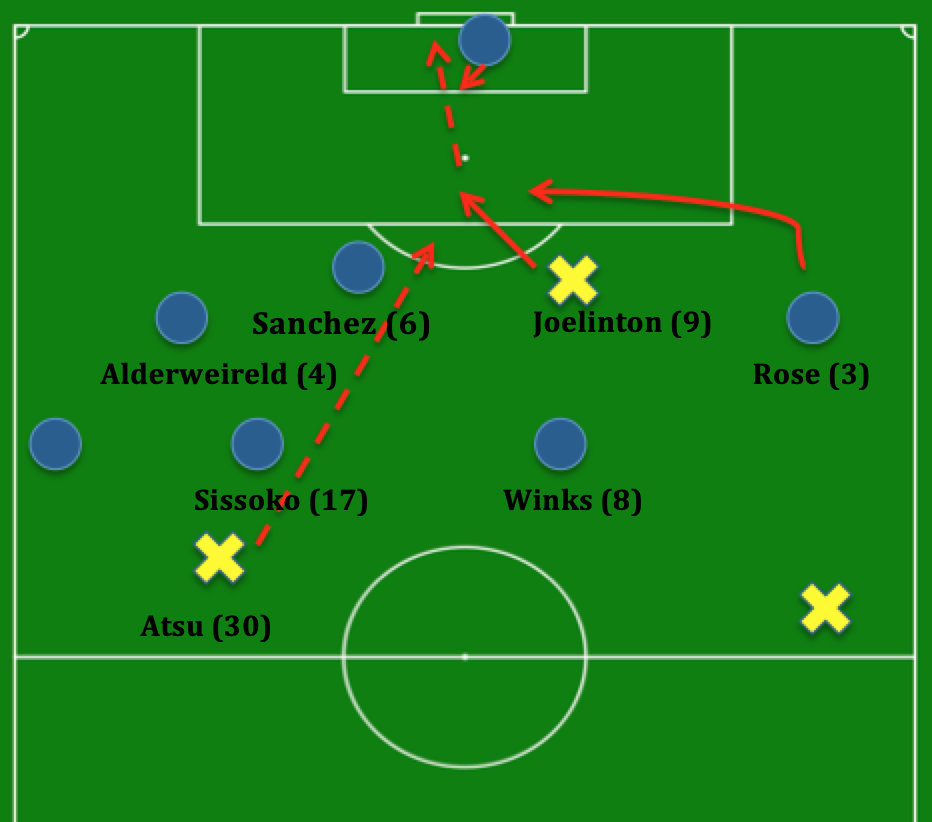
The goal conceded by Spurs – see diagram

Screenshot 2019-09-22 18.35.03

In the build-up to the goal, Tottenham had six outfield defenders behind the ball to Newcastle’s three attackers – six versus three.


Joelinton is positioned in the Spurs defensive backline.   The question is, from a defensive point of view, whose ‘zone’ is he in?   He is Newcastle’s main striker.   The next nearest Newcastle forward is the passer of the ball, Atsu.   One would expect that the responsibility for the marking of Joelinton must lie with one of the Spurs centre- backs.    Spurs defensive line is flat – three players in a straight line.


It would make sense, before the game even starts, that one of the two centre backs will assume responsibility for the marking of the opposition striker.   They may inter-change the role during the course of the game but one of them ought to be marking the centre forward at all times.   In this case it seemed neither were even thinking about man-to-man marking of the centre forward.


Sanchez, even if he was close and alongside the forward, it is doubtful he would have been able to stop Joelinton’s run.   The reason being he would not be goal side.   In this situation, the defender has to forget about playing offside or holding a defensive line.   He needs to drop-off and have the Newcastle forward, as well as the ball, in his sights.  By dropping off, he is actually taking up a position in the path where the forward is looking to run.   Adopting such a position is likely to discourage the ball being played in in the first place.   Yes, you are abandoning the defensive line.   This has to be an inevitable consequence if you want to ensure opposition players are marked.   If the Newcastle forward wanted to follow Sanchez into the box, the defender will still have a goal side position.   Whether the eventual ball is played in to the near post or far post, there is the opportunity to contest the ball.


The through ball was played into space and Joelinton, completely unmarked, one touch to control and second touch to score.   Rose could possibly have recognised the poor positioning of his centre back and provided some sort of cover of his own.   There was nobody on his side of the field to warrant attention.   Sissoko was only providing passive pressure on the provider of the pass, the killer-pass from Atso, which suggests he needed to be tighter on his marker.   Tottenham fans may recall the conceding of a similar goal in the first leg of the Champions League semi final that allowed Donny van de Beek to move between the static zonal backline of the Spurs defence.


Positional play, knowing when to hold the line and when to abandon it is a key element of playing zonal defence.   Zonal defending is asking a defender to operate in a shape-shifting space.  Having the instincts of knowing when, precisely when, to switch from a zonal format where one is potentially marking space to a man-to man format, where one takes personal responsibility for the marking of an opponent, only comes from understanding and playing man-to-man defence.   This is a problem if you are only use to playing zonal defence.


The football pundits seem incapable of analysing defensive play in any terms other than through the zonal format.   They will talk about the ‘two banks of four’ and trying to close the space; the playing ‘between the lines’, the ‘straight defensive line’ that has to stay intact no matter what.   The post mortem can invariably find the culprit who was not marking his man.


It would suggest that this process of marking does not seem to happen naturally within the zonal format.  Often, it doesn’t happen at all.  Why is that?   The sheer frequency of opponents getting free and not getting picked up suggests the fault lies with the system or the players’ interpretation of the system.


You may say, I am also guilty of identifying the roles of particular players and stating what their role should have been after a goal has been scored.   The difference is that I am framing solutions within a different system of defence, the man-to-man defensive system.   Perhaps I should not refer to it as that.   It is too confusing.   It is misinterpreted and dragged down by the more common term of ‘man marking’.   Why not just think of it in terms of marking opposition players, particularly when they have or are likely to receive the ball in dangerous areas.   Put simply, when does a defender switch from guarding space to marking an opponent?   This is football’s defensive conundrum.


Manuel Pellegrini and Frank Lampard need to spend time with their defence. — Aug 16, 2019

Manuel Pellegrini and Frank Lampard need to spend time with their defence.

West Ham 0 Manchester City 5

Manchester United 4 Chelsea 0

Two of the more eye-catching results from the first week’s games in the Premier League.

The two managers are at different stages in their respective managerial careers so we, perhaps, need to look beyond experience to gauge a reaction.   You’d be forgiven for thinking: is this an existential crisis brought on by VAR?

Four of the five goals Man City scored there wasn’t even a West Ham defender in attendance, at the point of execution.   This does include the penalty.   At least the Chelsea goals, with the exception of the penalty, there was some application of resistance provided by their defence.

The football correspondent, Barney Ronay, reporting on a move that City repeated throughout the first half: “One day someone is going to say hang it all and just play two full-backs instead.”    Observer 11-08-19

He makes a good point in so far as two defenders is better than one but is this realistic?   Switching to a team man-to-man format could provide the answer.

There is a Chinese saying that defeat should be celebrated because in the process your opponent is educating you.   I’m not sure if the West Ham and Chelsea fans will agree with that.   Both managers would claim that they played some good attacking football and didn’t deserve to lose by that margin.   Nonetheless, mistakes have been made and lessons need to be learned.

When you make mistakes it’s not about regretting them, it’s about saying, ‘How can I learn from that?’  The worst mistakes are the ones you just keep making.   It doesn’t matter how big or small.

Frank Lampard, to his credit, spoke after the game “For sixty minutes we were playing well other than the final third where we could have been more clinical.   We hit the post, we hit the bar…. then, 2,3-0 sucker punch, our mistakes, and the game changes completely.   A real lesson for us; mistakes will lose you games.”

Understanding the nature of mistakes

Where to start?    The first step to solving a problem is to see it clearly.

Man-to-man defending is my modus operandi.   This is definitely the team variety as opposed to the more conventional man-marking one.   There is considerable difference between the two concepts and for clarity I would direct you to previous blogs, ‘We are not defenceless’ which is a critique of zonal defending and/or ‘He’s behind you’.   Suffice to say with team man-to-man defending the priority is with the player on the ball and how other players can lend support to the teammate defending this player on the ball.

The question one needs to ask is whether the root cause of these many mistakes are to be found in the zonal system of defending?

Playing a zonal system, lethargy is always lurking.   The team man-to-man with its individual responsibility is a more flexible format that aims to provide an extra defender to contest the player on the ball.  Admittedly, this cannot always be achieved but it certainly has a considerably higher success ratio than standard zonal defending where often, particularly in the middle third, it is not possible to get even one defender marking the player on the ball.

In football, given the size of the playing area, it is possible for zonal defence to morph into a team man-to-man structure.   Playing man-to-man is a completely different mindset and specifically addresses the fundamental issue of marking opponents.   Significantly, a team man-to-man defensive shape will not have a straight defensive line.   This is because it is impossible to mark an opponent effectively without being goal-side of them.   Yet, football seems to persist in this.   There are situations in a game when the abandoning of the defensive line has to be an inevitable consequence in order to provide effective defence.   Most notably when either the play gets close to one’s own goal or when there is no pressure on the ball carrier.

The second goal conceded by Chelsea

A ball won by Harry Maguire at the top of his box enabled Man United to break quickly through an initial short outlet pass from McTominay to Rashford and ten seconds later Anthony Martial was scoring at the other end.

Diagram 1
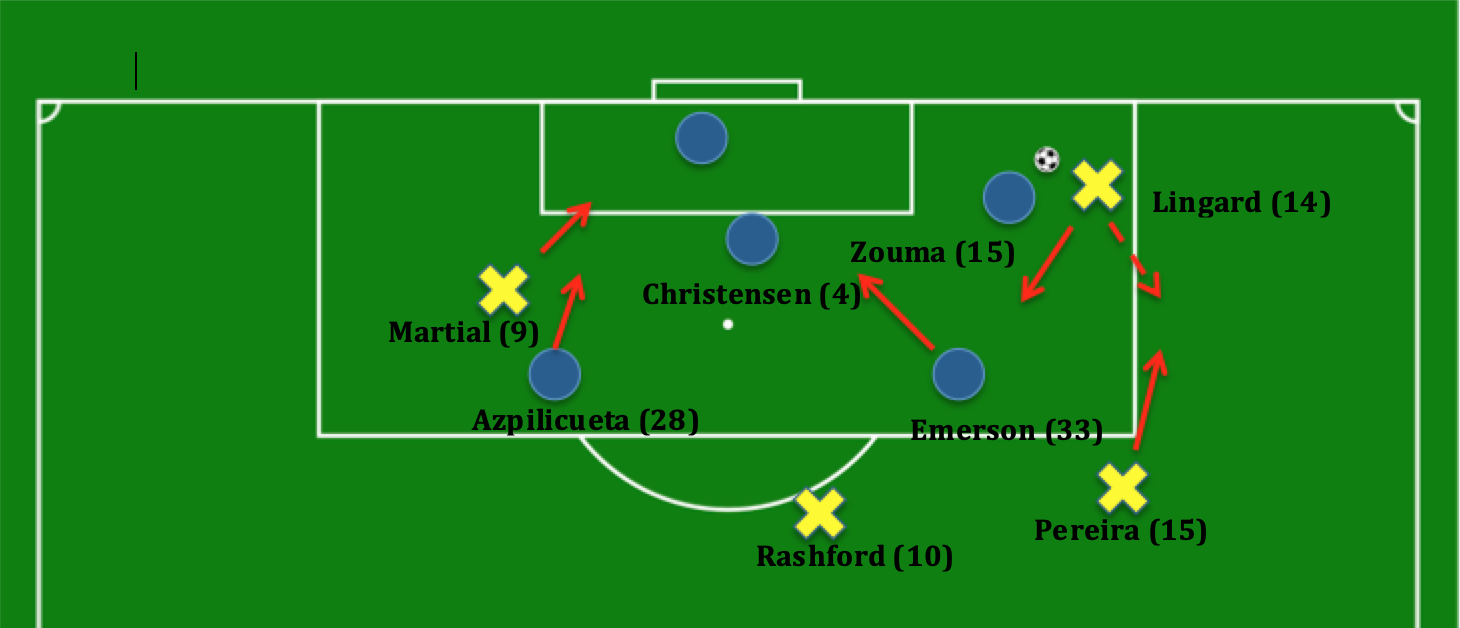
Move3

The fine detail when it comes to movement and understanding defensive play.

Points of interest (Diagram 1)

  • Zouma is isolated in a one-versus-one with Lingard.
  • Lingard has support from Pereira. Zouma potentially has support from Emerson.   But Emerson, instead of moving towards the ball and thereby help out Zouma, chooses to move towards the goal.   With Lingard now receiving support from Pereira, Zouma is in a one-versus-two situation.
  • Further, Azpilicueta is not goal-side of Martial. This is the time to abandon any thoughts of a defensive line.  Azpilicueta needs to position himself firmly inside the six yard box with an open body shape so he can see both the ball and Martial.

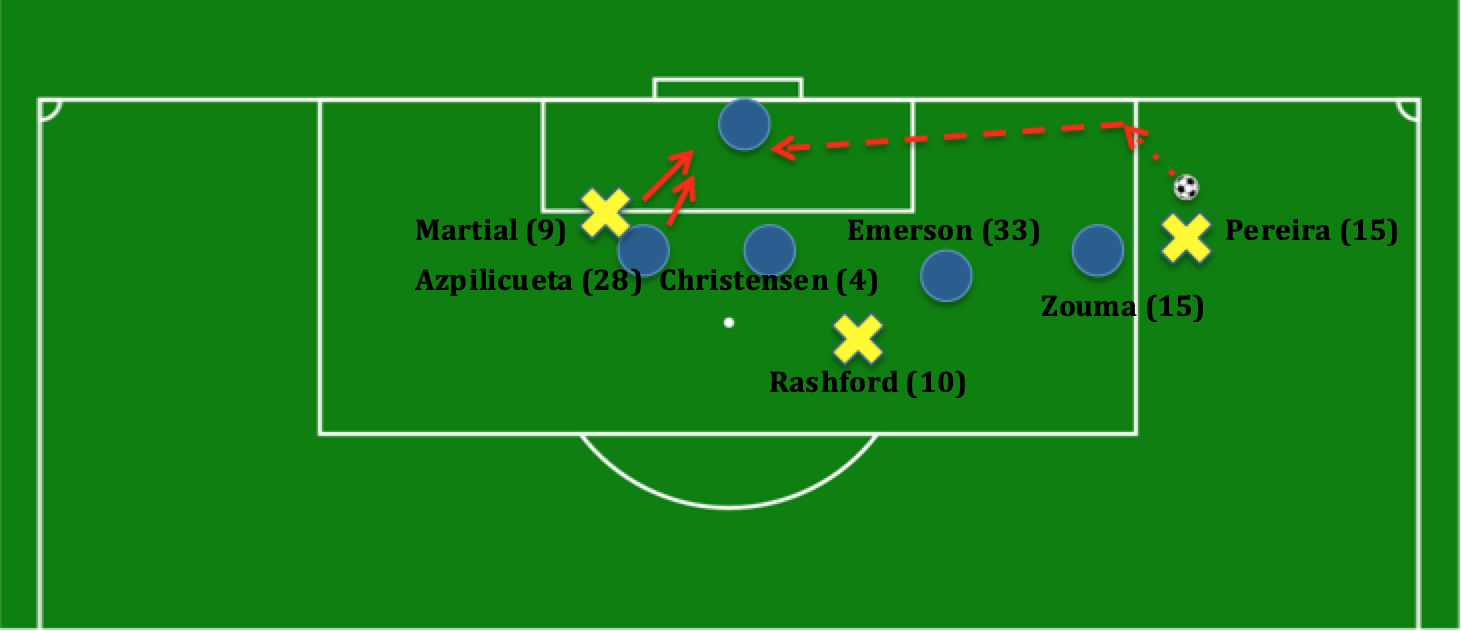
Diagram 2
Move2

At this moment in time, there is no point in trying hold a defensive line or play for offside.   The need is for opposition players to be marked man-to-man.

Points of interest (Diagram 2)

  • The two key players that pose a potential attacking threat are Rashford and Martial.
  • Chelsea have two players that could match up with them; Christensen with Rashford and Azpilicueta with Martial – although as has already been identified Azpilicueta needs to be goal-side.

Had Azpilicueta positioned himself in the six yard box by breaking a gut to get there early on in this sequence, before even Pereira had touched the ball, this would have meant that he was in a position to meet the run of Martial towards the near post.   Thereby possibly preventing the goal being scored.

Is this a mistake by Azpilicueta?   By Emerson?  By Zouma for not making sure he got the help he needed?   These are the fine margins and technicalities of playing good defence.  The characteristics and mentality associated with playing man-to-man defence.

The zonal mentality does not provide this awareness of identifying danger and then being able to respond in the appropriate manner.   For example, was Azpilicueta even aware that Martial is his responsibility?  It doesn’t matter if you’re playing zonal defence or man-to-man defence, he has to be the man to take responsibility.

By implication, Azpilicueta cannot possibly take responsibility for Martial if he is not goal-side.   Better still, to be goal-side and with a few yards to spare in order to deal with the near post run.

Third goal

Move1

Arguably, Azpilicueta was also guilty of trying to hold a defensive line, a high line, and then finding himself, trailing Rashford for the third goal.   Is this again a case of one player not realising the specific moment when you have to abandon the defensive line in favour of marking an opponent?

In his defence, there was no pressure on the ball when Pogba released the telling pass from his own half.  This is another characteristic of zonal defending.   But it ought to serve as a cue to defenders that they must be on the look out for situations like this, especially when playing a high line.

Defensive play is largely about understanding the complexities of where a player should position themselves according to different circumstances.   The team man-to-man, as the name suggests, is about helping out teammates with special emphasis to the teammate who is defending against the player on the ball.

The ‘man-marking’ concept, which is more familiar to football, isolates one player against another and it is exactly this situation that you want to avoid.   The main threat in any defensive situation is the player on the ball.   Rather than have defenders closely marking opponents who have not got the ball, their contribution should be focussed on providing assistance to the teammate who is marking the player on the ball.   The defenders in the closest proximity will obviously be able to provide more substantial support.

Basketball can provide a blueprint here.   It is recognised in this sport that in any one-versus-one situation, nine times out of ten, the attacking player is likely to prevail.   Put a second defender there and the defence is likely to prevail.

The basketball fraternity, who know all about zonal and man-to-man defence, do have a little secret.  They know players cannot possibly understand and play effective zonal defence until they have mastered man-to-man defence.

VAR and the Women’s World Cup — Jun 28, 2019

VAR and the Women’s World Cup

Spain 1 USA 2        24 June 2019

VAR decisions are proving to be quite influential in the outcome of football matches in this world cup.  USA’s advance to the quarter final, at the expense of Spain provided VAR controversy over the awarding of a second penalty.   Contact by the Spanish defender Virginia Torrecilla was confirmed and even though Rose Lavelle fell to the ground, she was going away from goal and unlikely to produce a shot on goal.   But, this kind of detail is no longer relevant with VAR.   There was contact in the box – penalty.

This interpretation of the awarding of penalty kicks has huge implications for defensive technique.  Defending will be much more like defending in basketball in the future.   Here, a defender is deemed to have control of space that is confined to an imaginary cylinder; arms must be by one’s side and legs must be in their customary shoulder-width stance.

In basketball, the significance of body position is more to do with an arm coming out of this cylindrical space.   In football, it is legs that are likely to protrude with the intention of winning the ball.   In both sports now, if contact occurs when defenders have moved a limb outside of this cylindrical shape, the onus is with the defender, not the attacker.

The reality of football in the future with VAR is, as soon as a defender’s leg is extended to meet the ball, the player is potentially risking the awarding of a penalty kick.  There is always the option of a clean contact on the ball but attacking players will now, with the advent of VAR, be looking to contact the out-stretched leg.

The mantra for a defender of not trying to win the ball is going to be more important than ever.  Defenders must resist the temptation of trying to win the ball in favour of a more “shepherding” role to make sure they stay with the attacker and maintain a goal side position.

The defensive technique for this is quite different.   John Terry, the former Chelsea stalwart, has spoken about the technique adopted by some teams in Europe, “You have to move like a crab moving sideways.   You cannot afford to try to win the ball, they are too quick”.   MOTD2 4-11-18.   This theme has been discussed in a former blog: What’s basketball got to do with it?

Spain had earlier cancelled out USA’s first penalty of the game when Jenni Hermoso capitalised on an error by Becky Sauerbrunn who was trying to play out from the back.   Both spot kicks were scored by Megan Rapinoe to put the Americans through.   The defending champions now face the hosts, France, in Paris on Friday.